7 Mathematical Learning and Pedagogy
7.1 The Learning Process
Memory
It takes years of learning and practice to develop and acquire the use of memory as a learning tool. A 5-year old’s ability to concentrate and therefore to memorise, is non-expert and their approach appears to be cursory and haphazard. By the age of 11, children have learnt how to structure what needs to be memorised (e.g. categorisation).
Try to get the pupils you work with to remember what you did with them on the previous visit. This will help to reinforce the progress made, and will help the pupils to build on memorising skills.
Concentration
Younger children can have impulsive and brief attention spans.
- When dealing with them on a one-to-one basis, start with general chat to find out what their concentration is like
- Tune in to their responses - it is much easier to employ approaches to the task if you know how your pupils are likely to react
- Use a limited time for each activity (don’t labour a point if the pupil does not show interest)
Wholes and Parts
Children under the age of 6 do not generally recognise a larger whole made up of smaller parts. So don’t expect them to get the ‘Big Picture’ - help them to create it by using the parts they know.
Effective
Use your own positive learning experiences that have worked well for you.
- If the child struggles, judge how soon you need to intervene. Too hasty and it looks as if you do not have confidence in them, but too slow and they will start to get over-anxious
- Try to always use a ‘Can do’ attitude
- Try to relate the subject to the child’s own experience - this way they can understand it better rather than be left with an abstract concept
Always try to end each session on a positive note.
7.1.1 Four Ways of Learning
Trial and Error
What is it?
This is probably the simplest form of learning. Learners try to do something and learning takes place when they succeed or fail in their attempt. People who do not have time to train thoroughly often use it. Common phrases used are “Oh you’ll soon pick it up” or “You’ll learn as you go along”.
Advantages
- Little preparation required
- Minimal resources needed
Disadvantages
- Lots of mistakes made at the outset
- Can de-motivate
- Feeling of isolation
How to use trial and error as a learning tool
Opportunities for practising trial and error learning should be created around practical, realistic activities. The opportunities should be learning events that are structured rather than unstructured, i.e., events that the trainer has carefully planned. An important feature of trial and error is reinforcement either by praising and confirming that the attempt was correct (positive reinforcement) or constructively criticising for making an incorrect attempt (negative reinforcement).
Being Told
What is it?
The basis of this way of learning is that the learner receives some information (words, symbols or figures) from the trainer, e.g. the Highway Code when learning to drive. The entire content of what is to be learnt is presented to the learner in a final form: “Sit down and I’ll tell you what you need to know” or “Listen carefully, I’ll just go over what you have to do”.
Advantages
- Quick for trainers
- Can deliver lots of information to a large number of people
- Limits questions and discussion
Disadvantages
- Limits independent thought - no improvement in process
- Does not encourage interaction between learners
- Creates more questions after training
How to use being told as a learning tool
Useful for situations where there is a clear-cut body of knowledge with a minimum amount of ambiguity and where the task does not require the learner to make any independent discovery. How much a learner learns depends upon:
- The amount to be remembered. If it is only a small amount, the learner can simply be told. A larger amount of information should be presented in written form for referral.
- The complexity of the information. With more complex topics, it is usually better to represent the information using as well as oral explanation.
Imitation
What is it?
In learning imitation, a learner observes somebody performing a task which the learner then attempts to imitate, eg, “Sit next to Nellie, you’ll learn a lot from the way she does things” or “Just watch me, I’ve been doing it for years”.
Advantages
- Help and advice is always available
- Learn from an experienced person
- Informal
Disadvantages
- Learn bad habits
- Limited to individuals and small groups
- Time consuming - may lead to resentment from trainer
- Personality conflicts
How to use imitation as a learning tool
The ‘model’ which a learner imitates should be a positive influence on a learner’s behaviour by demonstrating the correct way to do something. The method of learning requires careful consideration by the trainer - if it is ill-prepared and unstructured, the learner will be exposed to (and learn) probably as many bad working practices as good ones.
Thinking
What is it?
Learning can occur when a learner is encouraged to think about an experience and reflect on it in learning terms. Using such questions as “Why do you think that happened?” and “What would you do if you were to repeat it?” the trainer is able to create a learning event within which complex situations can be thought about and discussed.
Advantages
- Lends itself to group discussion and
- Retained in memory for longer
- Carry out difficult procedures in a controlled environment
Disadvantages
- Requires skilled trainer
- Can be challenging to some people
- Time consuming
How to use thinking as a learning tool
It might be that there is not a simple, clear-cut answer. The learner might be presented with a number of options, each one having some advantages to offer. Learning can take place when the learner has to , consider consequences and generally ‘think through’ the situation. The maturity and experience of the learners relative to the thinking required needs to be taken into account. What is a complex and demanding thinking experience for one learner becomes a simple situation all too easily solved for another.
7.2 Theories of Learning
7.2.1 Zone of Proximal Development (Guy-Evans 2022)
The () is a learning theory developed by psychologist Lev Vygotsky. It describes the gap between what a learner can do independently and what they can achieve with guidance from a , such as a teacher, mentor, or peer. It helps explain how effective supports learners in progressing from confusion to confidence.
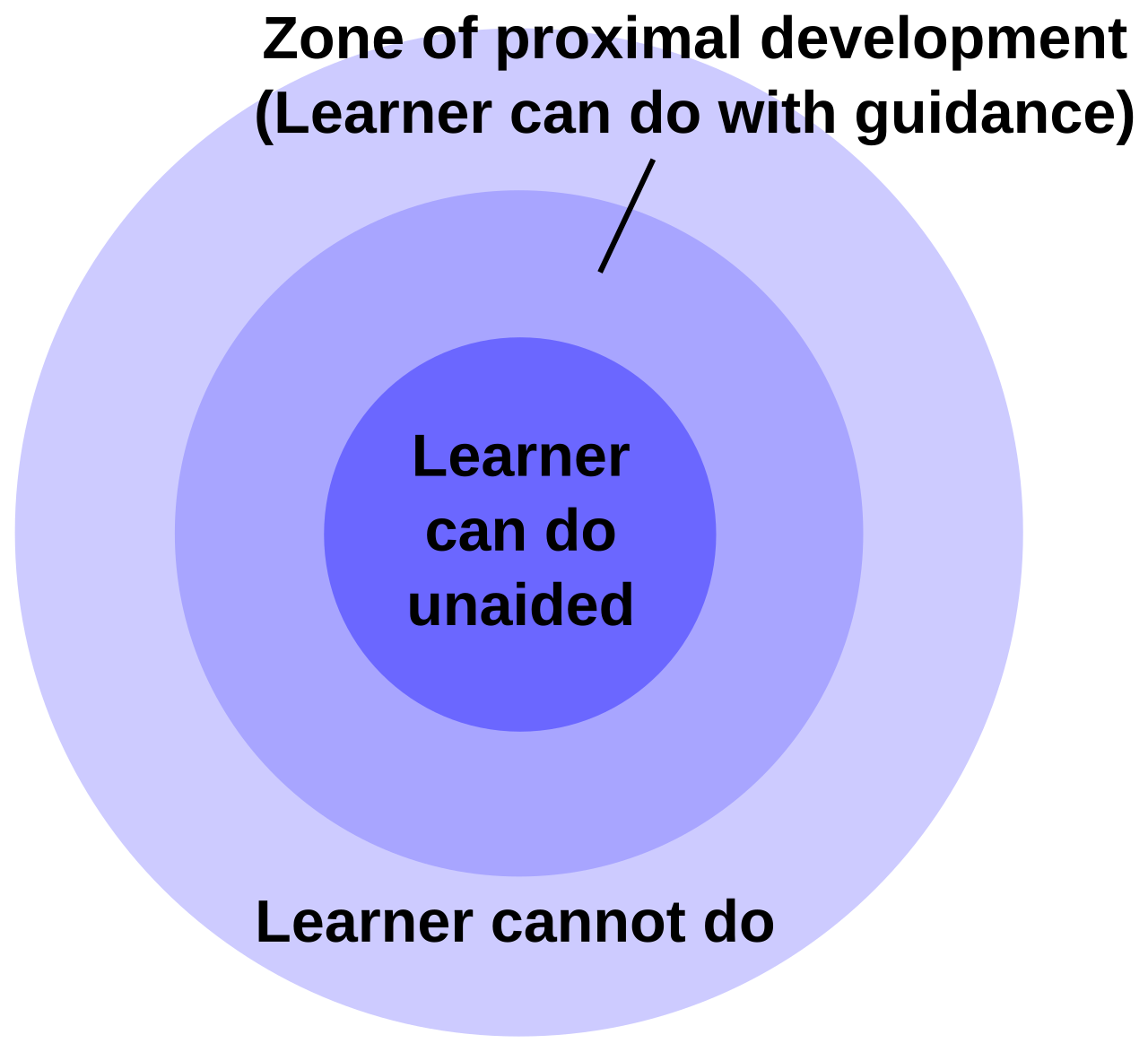
For students on this module, the also highlights an important principle of and teaching: effective learning occurs not through passive listening, but through guided participation, communication, reflection, and gradual independence. Ultimately, successful involves helping the audience move from supported understanding to independent mathematical thinking.
The best learning happens when mathematical tasks are slightly beyond a student’s current ability, but still achievable with support. If a task is too easy, little learning occurs; if it is too difficult, learners may become frustrated or disengaged. Effective therefore aims to work within students’ by providing the right level of challenge and support.
7.2.1.1 Core Components of the ZPD
7.2.1.1.2 More Knowledgeable Other (MKO)
The () refers to anyone with a higher skill level than the learner, such as a teacher, parent, or peer. The provides the essential bridge between current ability and potential mastery by guiding pupils towards discovering understanding for themselves, rather than simply providing answers.
7.2.1.1.3 Support
is the temporary support system that helps learners progress through their until they gain the confidence and competence to perform tasks independently. The level of assistance is high when a task is new and is gradually withdrawn as the learner gains competence. In mathematics, may be provided through , visual representations, sentence starters for explanations, or partially completed solutions.
7.2.1.1.4 Internalization
Knowledge begins as an external, social experience. Through dialogue and shared problem-solving, learners transform these external tools and language into their own internal cognitive structures. In mathematics, pupils first encounter ideas through classroom discussion, teacher modelling, and collaborative activities. Over time, these external conversations become part of the learner’s own internal thinking processes.
7.2.1.2 Practical Examples
Common examples of learning within the include a teacher modelling a mathematical problem before students solve a similar problem independently, or a peer explaining a new concept during group work. In both situations, communication serves as the mechanism through which understanding is developed and transferred.
7.2.1.3 Educational Value
Understanding the helps educators design lessons that challenge students just beyond their current abilities, promoting growth without causing frustration. By recognising where a pupil’s current understanding lies, teachers can provide effective , improve , encourage deeper , and build learner confidence.
The is particularly relevant to because it emphasises that learning is not simply the transmission of information. Instead, understanding develops through purposeful interaction, discussion, questioning, and feedback. Effective mathematical communicators therefore act as facilitators who support learners in constructing understanding and gradually becoming independent mathematical thinkers.
7.2.2 Zull’s Model of Learning (Gutierrez 2014)
According to neuroscientist James Zull, learning occurs through a cycle of brain processes that help learners experience, interpret, create, and apply knowledge. Zull’s model reminds us that mathematics learning should not focus solely on passive note-taking. Instead, students should be encouraged to create meaning, communicate reasoning, and develop their own mathematical voice .
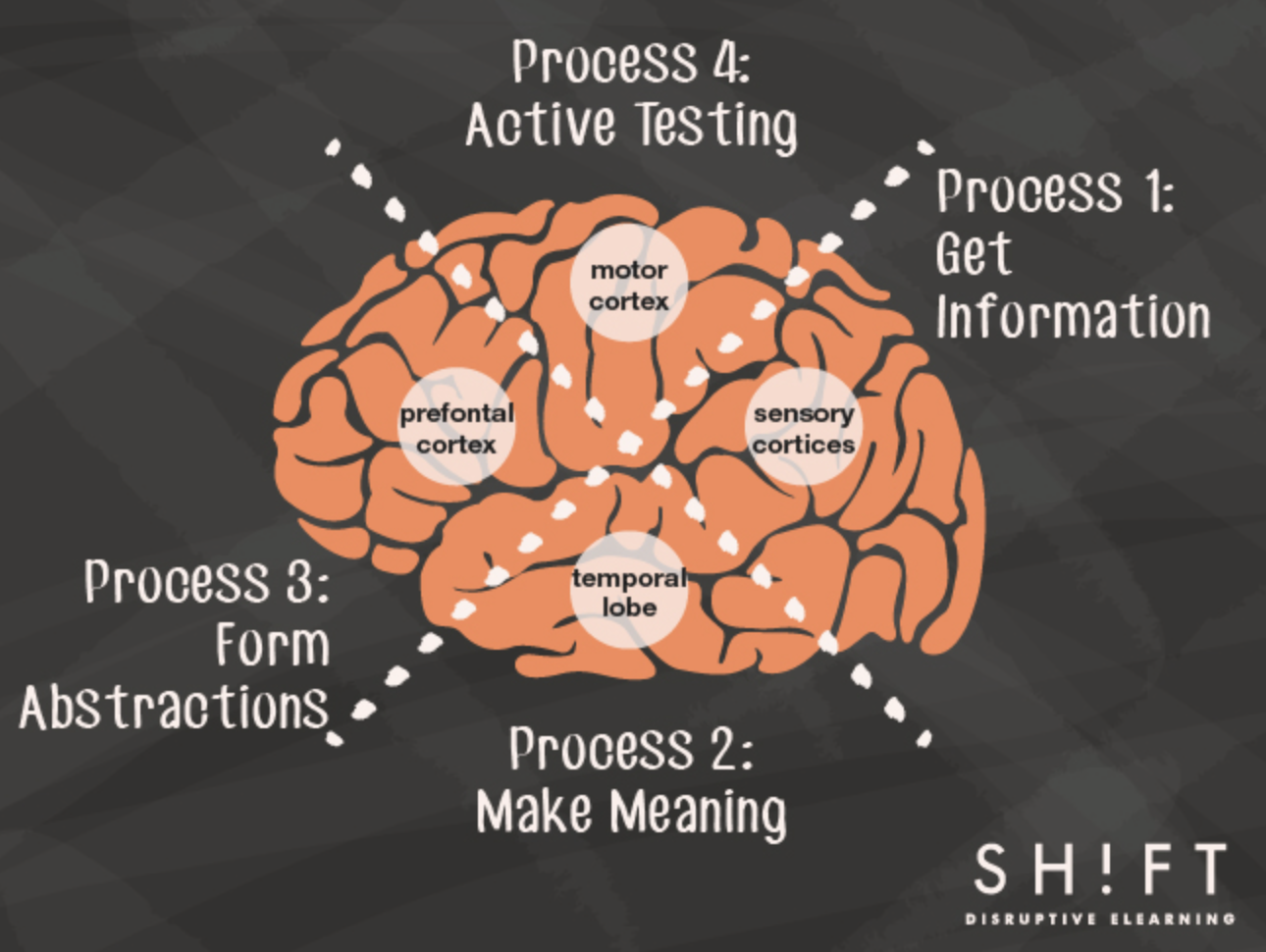
- Process One: Gathering Mathematical Information
The first stage of learning involves collecting information through the senses. In mathematics, this occurs when students:
- read definitions, symbols, and explanations,
- observe ,
- listen to lectures or discussions,
- examine graphs, diagrams, and visual representations,
- interact with mathematical tools and technology.
At this stage, students are exposed to the raw materials of mathematics. These may include equations, patterns, proofs, data, or mathematical language. Clear communication is especially important here because students must first see and hear mathematics in understandable ways before meaningful learning can occur.
For example, a teacher who explains a graph verbally while also using visual representations helps learners gather information through multiple channels.
- Process Two: Making Meaning in Mathematics
Once information is gathered, the brain begins searching for meaning. Learners reflect on mathematical ideas, connect them to prior knowledge, and begin understanding why methods work rather than simply memorizing procedures.
In mathematics, mathematical interpretation occurs when students:
- explain concepts in their own words,
- compare different solution methods,
- identify patterns and relationships,
- discuss reasoning with peers,
- reflect on mistakes and .
This stage highlights the importance of . When students are encouraged to talk, write, and reflect about mathematics, they move beyond passive learning and develop genuine .
Reflection also requires time and space. If mathematical content is delivered too quickly or overloaded with information, students may struggle to process ideas deeply. Effective mathematics teaching therefore includes pauses for discussion, questioning, and reflection.
For example, asking students to “Convince yourself, convince a friend, and convince an enemy” encourages deeper meaning-making and towards their mathematical approaches.
- Process Three: Forming Abstractions and Creating Mathematical Understanding
At this stage, learners begin constructing their own mathematical understanding. Rather than simply receiving knowledge, they start creating connections, generalizations, and abstractions.
In mathematics, this may involve:
- developing conjectures,
- forming general rules from examples,
- modelling real-world situations mathematically,
- creating diagrams or representations,
- explaining mathematical ideas to others.
Communication plays a central role because expressing mathematical ideas forces learners to organize and clarify their thinking.
For example, asking students to link a mathematical concept to a real-world situation encourages reflection on generalizations and relevance of the mathematics they have learnt, cementing it in their brain as they are actively creating meaning rather than memorizing information.
- Process Four: Active Testing in Mathematics
The final stage involves applying and testing understanding through action. Learners use mathematical ideas in practical, communicative, and contexts.
Active testing in mathematics may include:
- solving unfamiliar problems,
- presenting solutions to classmates,
- participating in mathematical discussions,
- ,
- teaching concepts to peers,
- using to improve explanations.
Through active testing, students discover whether they truly understand a concept. becomes essential because learners must articulate reasoning clearly, defend arguments, and respond to questions.
For example, a student explaining a solution to the class is not only practicing communication skills but also strengthening their .
7.2.1.1.1 Social Interaction
Vygotsky emphasized that learning is a social process, where interaction and dialogue help students move from guided to independent mastery. In a classroom setting, this could occur through discussions, questioning, and collaboration between pupils. For instance, asking “Can you explain how you got your answer?” encourages pupils to communicate their thinking rather than simply provide answers.